
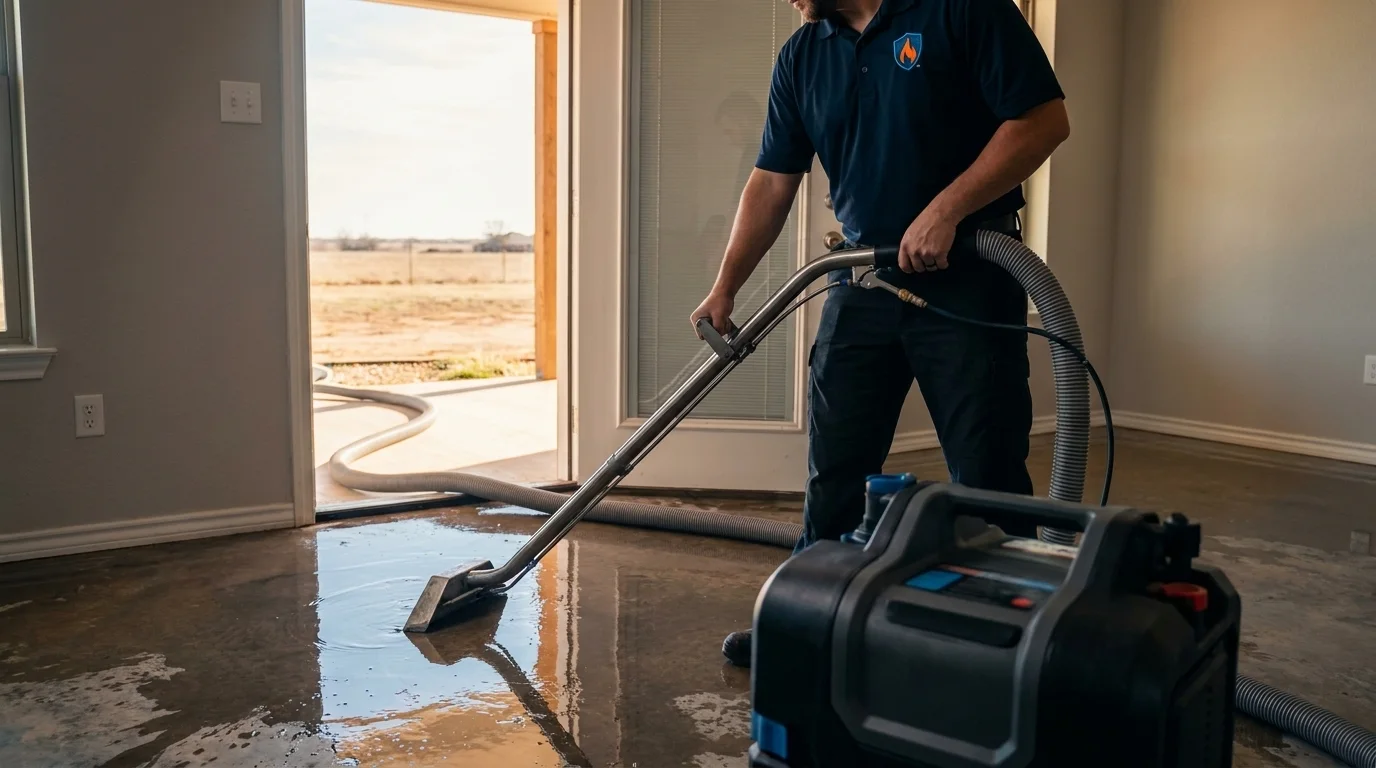
24/7 Emergency Flood Damage Restoration in Anson
24/7 emergency flood damage restoration in Anson, TX. IICRC-certified, insurance billing accepted. Call (325) 339-8723.
Our IICRC-certified technicians are dispatched from our Abilene, TX headquarters and are typically on-site in Anson within 60 minutes of your call.
Flooding emergency in Anson? We answer 24/7. Call now and our crew heads out to pump out the water and stop the damage from spreading.
Flood damage in Anson rarely looks like the dramatic, waist-deep water people picture. More often it’s a slab foundation that’s taken on water through the perimeter after a hard West Texas thunderstorm, or a crawlspace under an older Jones County farmhouse that’s stayed damp for days because nobody knew to check it. Flood damage restoration here has to account for flat terrain, clay-heavy soil, and a housing stock where a lot of homes were built before modern moisture barriers were standard.
Why Anson Properties See Flood Damage
Jones County sits on rolling plains with clay-based soils that don’t drain quickly. When a storm dumps a heavy rain total in a short window, which happens more than a few times a year in this part of Texas, that water has nowhere fast to go. It pools against foundations, backs up through weep holes, and finds its way into crawlspaces and slab-on-grade homes that were built without the grading standards common in newer subdivisions. Older homes around Anson, many built decades before current drainage codes existed, are especially prone to water tracking along foundation cracks and settling points rather than running off the way it would on newer construction. Once water sits against a slab or under flooring for more than a day or two, the risk isn’t just structural, it’s biological: drywall paper and wood framing can start supporting mold growth within 24 to 48 hours in warm, humid conditions.
Our Flood Damage Restoration Process in Anson
The first visit is about finding water that isn’t visible yet. Flooring can look dry on the surface while subfloor and insulation underneath stay saturated for days, so we use moisture meters and, where needed, thermal imaging to map how far the water actually traveled. From there it’s extraction, then structural drying using air movers and dehumidifiers set to pull moisture out at a rate the materials can actually handle, rather than just blasting heat and hoping. Wood-frame homes with crawlspaces need a different airflow strategy than slab homes, and we adjust equipment placement based on which one we’re dealing with. Drying is documented daily with moisture readings so there’s a clear record showing the structure returned to a normal moisture standard before we close the job out, which matters both for your peace of mind and for insurance documentation.
Reaching Anson from Abilene
We’re based out of Abilene, and the drive north into Jones County is short enough that we treat Anson calls the same as calls closer to home. Because floodwater intrusion gets worse by the hour, especially with the clay soils here holding moisture against a foundation longer than sandier ground would, we schedule flood calls as priority dispatches and work day or night, since we’re staffed around the clock. Rural properties on the outskirts of town sometimes have longer driveways or limited turnaround space for equipment trailers; when that’s the case, we ask a few questions on the intake call so we’re not guessing about access once we arrive.
Anson Insurance Coordination
Most flood claims in this area come down to one question early on: is the water damage covered under a standard homeowner’s policy, or does it fall under flood insurance because the water originated from outside the home versus a plumbing failure inside it. We document the source of the water, the affected materials, and moisture readings as we go, which gives your adjuster (or your flood policy carrier, if that’s what applies) a clear paper trail instead of a dispute over what happened. We’re an IICRC Certified Firm and our technicians carry IICRC Water Damage Restoration Technician training, so the drying protocol we follow lines up with the standard most carriers expect to see referenced in a claim file.
Local note
One pattern we watch for specifically in Jones County: homes with older pier-and-beam foundations often have crawlspace vents that were sized for ventilation, not for keeping storm runoff out. After a heavy rain event, water can enter through those vents even when the visible yard drainage looks fine, so we check crawlspace moisture on every flood call out here even if the homeowner hasn’t mentioned it as a concern.
If your Anson property has taken on water from a storm, a slow foundation leak, or an overwhelmed drainage path, the time between the water arriving and the drying starting matters more than almost anything else in how the job goes. Call Air Care Restoration at (325) 339-8723 and we’ll walk you through what to check before we’re even on site.
Serving Anson from our Abilene headquarters — ★ 5.0 · 22 Google reviews
“Sarha with Air Care Restoration is a life savor. Our toilet overflowed causing sewage to flood our bathroom, hallway, and one of the bedrooms. Air Care Restoration answered our call, questions, and showed up in less than 45 minutes on a Friday night. This was our first time experiencing water…” — Adam, September 2026Read our reviews on Google →
Flood Damage Restoration in Anson: Service Coverage
Frequently Asked Questions
How fast can you arrive for flood damage restoration in Anson?
How does Jones County's clay soil affect flood damage restoration in Anson homes?
Are older pier-and-beam homes around Anson more vulnerable to flood damage than newer construction?
How fast can Air Care Restoration respond to a flood call in Anson from your Abilene location?
What does the flood damage drying process actually involve?
Will my homeowner's insurance or a flood policy cover flood damage restoration in Anson?
Flood Damage Restoration response in Anson
Most Anson calls see a technician on-site within 60 minutes from our Abilene headquarters.