
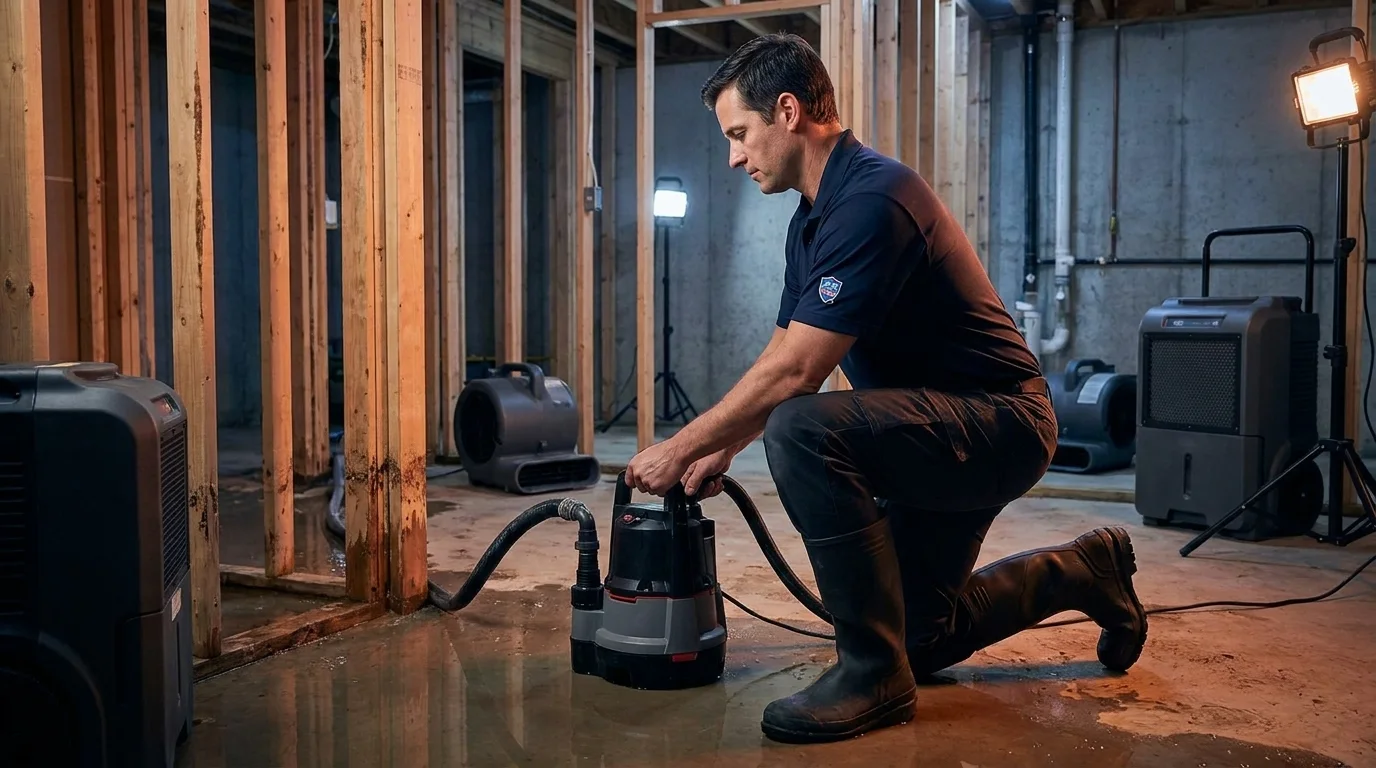
24/7 Emergency Basement Flooding Cleanup in Abilene
24/7 emergency basement flooding cleanup in Abilene and surrounding areas. IICRC-certified, insurance billing accepted. Call (325) 339-8723.
Flooded basement in Abilene? We answer 24/7. Call now and our crew heads out to pump out the water and start drying.
A flooded basement rarely comes from rain alone. It’s usually a sump pump that quit during the storm, a hairline crack in the foundation wall that finally gave way under hydrostatic pressure, or a sewer line backing up through a floor drain. Whatever the source, water sitting on a basement slab starts wicking into drywall, insulation, and framing within hours, and the musty smell that follows is often the first sign homeowners notice before they see the damage itself. Basement flooding cleanup in Abilene has to address both the standing water and what it’s already done to the materials around it.
What basement flooding cleanup actually involves
Basements and below-grade rooms behave differently than the rest of a house during a water loss. Concrete and concrete block absorb moisture slowly and release it even more slowly, which means a slab that looks dry to the touch can still be saturated several inches down. Finished basements add another layer of risk: drywall wicks water upward past the visible waterline, baseboards trap moisture against the wall plate, and carpet pad usually has to come out entirely since it holds water the carpet itself sheds. Basement water removal starts with pumping out standing water, but the real work is in drying the structure itself, not just the surface, and confirming that with moisture meters rather than a visual check.
Our process
- Source control - before anything else, the water source gets identified and stopped, whether that’s a failed sump pump, a cracked foundation wall, or a sewer backup that needs to be isolated as a Category 3 loss.
- Extraction - submersible pumps and truck-mounted extractors remove standing water from the slab, then wet-vac passes handle water trapped in carpet, pad, and low spots along the foundation perimeter.
- Moisture mapping - moisture meters read the concrete, block cores, drywall, and framing to establish how far the water traveled, since basement walls can hold moisture well above the visible waterline.
- Controlled drying - air movers, dehumidifiers, and in some cases negative air setups bring humidity down across the basement, with drying targets based on the moisture readings rather than a fixed number of days.
- Monitoring and reassembly - daily moisture checks confirm the slab, wall cavities, and framing have returned to a dry standard before flooring, drywall, or baseboards go back.
What separates a good basement flooding response from a bad one
The most common mistake in wet basement restoration is treating it like a normal room-level water loss. Below-grade walls need to be checked at the core, not just the surface, because concrete block can hold water in the hollow cells long after the face looks dry. Drywall hung below grade should almost always be cut a few inches above the highest water line rather than just dried in place, since the paper facing wicks moisture upward and can support mold growth even after the visible area dries. Insurance adjusters generally look for documented moisture readings at each stage, not just before-and-after photos, and for a clear explanation of why materials were removed versus dried in place. Skipping the root-cause fix, patching a cracked wall without addressing grading or sump pump capacity, is how the same basement floods again next season.
What does basement flooding cleanup cost?
Costs vary with how much water was involved, how long it sat before cleanup started, and whether the basement is finished or unfinished. A sump pump failure caught quickly in an unfinished basement costs far less to resolve than a sewage backup that soaked carpet, drywall, and stored belongings. Every loss is different, and Air Care Restoration provides a written scope of work before any work begins so you know exactly what’s being done and why. Most homeowners insurance policies cover sudden and accidental water damage, such as a burst pipe or sump pump failure, but typically exclude flooding caused by surface water or groundwater unless a separate flood policy is in place.
| Scenario | Typical range |
|---|---|
| Sump pump failure, unfinished basement, caught early | $800 - $2,200 |
| Finished basement, drywall and carpet affected | $2,500 - $6,000 |
| Foundation crack with hydrostatic water intrusion | $1,800 - $4,500 |
| Sewage backup (Category 3), finished basement | $4,000 - $9,500 |
| Large finished basement with furniture and built-ins | $6,000 - $14,000 |
Seasonal & regional considerations
Abilene’s clay-heavy soil expands and contracts significantly with rainfall, and that movement is a common cause of foundation cracks that let water into basements and below-grade rooms during heavy storms. West Texas rain tends to arrive in short, intense bursts rather than steady soaking rain, which means a lot of water hits saturated ground fast and looks for the nearest low point, often a basement window well or foundation seam. Homes with sump pumps are especially vulnerable during these events if the pump wasn’t sized for a sustained high-volume pump-out or if the power goes out during the storm itself.
Service area
Air Care Restoration handles basement flooding cleanup for homes and properties throughout Abilene and the surrounding communities, including Tuscola, Merkel, Clyde, and Baird.
If your basement has standing water or that telltale musty smell after a storm, call (325) 339-8723 to schedule basement water removal and get a written drying plan started before the damage spreads further into the structure.
Services We Handle
- Basement Flood Cleanup
Frequently Asked Questions
Does homeowners insurance cover basement flooding cleanup?
How fast can mold start growing in a flooded basement?
Do you have to remove drywall and insulation after a basement flood?
What's the difference between a sump pump failure and a sewage backup for cleanup purposes?
How long does it take to dry out a flooded basement?
Looking for the best basement flooding cleanup company in Abilene?
Air Care Restoration provides licensed and insured basement flooding cleanup in Abilene, TX and the surrounding area, and has served local property owners since 2026. Customers rate us 5.0 out of 5 stars across 22 Google reviews. We answer calls 24/7 — call (325) 339-8723 for immediate help.
Need Basement Flooding Cleanup now?
We respond 24/7 across Abilene and surrounding TX cities.
Related Coverage
- Our Restoration Services
- Contact Air Care Restoration
- Restoration Services in Albany
- Restoration Services in Anson
- Restoration Services in Baird
- Restoration Services in Ballinger
- Restoration Services in Bronte
- Restoration Services in Brownwood
- Restoration Services in Buffalo Gap
- Restoration Services in Clyde
- Restoration Services in Coleman
- Restoration Services in Colorado City
- Restoration Services in Comanche
- Restoration Services in Early