
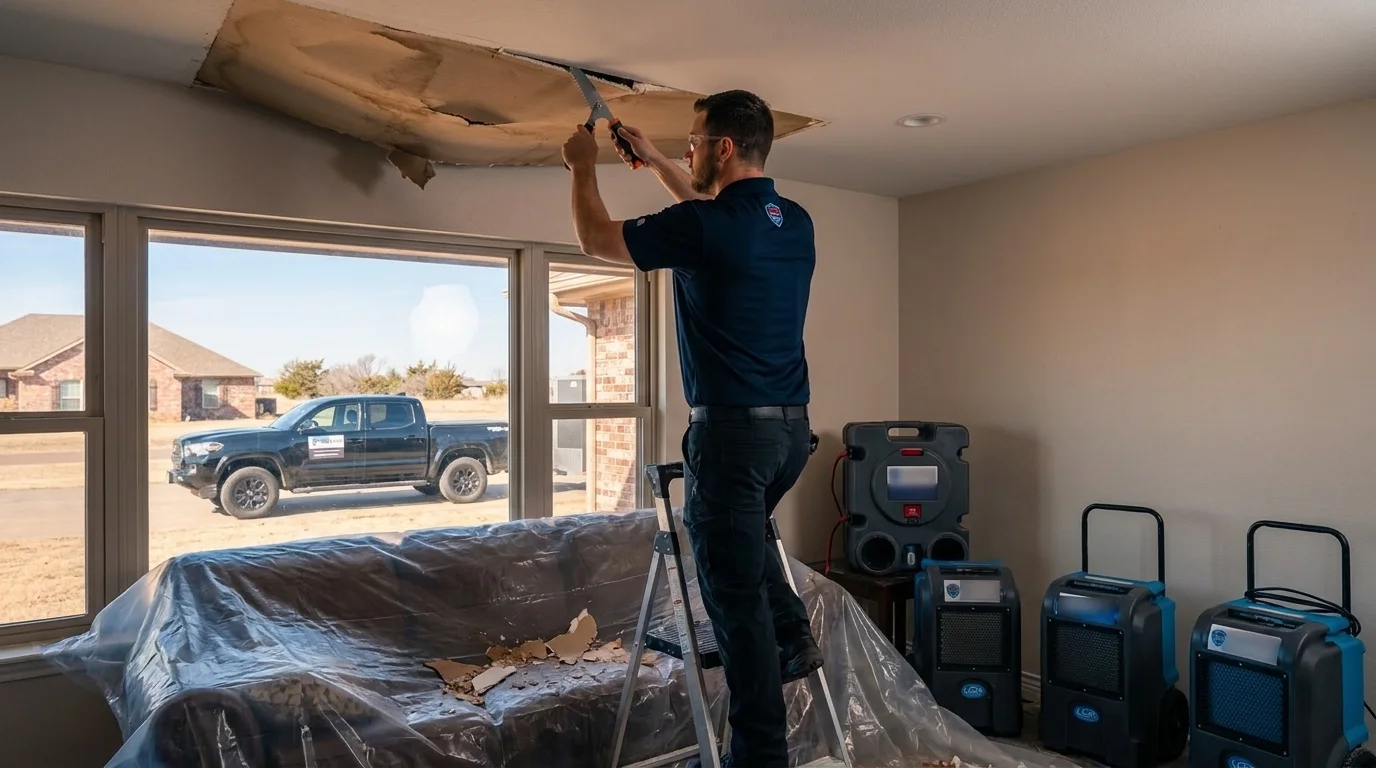
24/7 Emergency Ceiling Water Damage Repair in Abilene
24/7 emergency ceiling water damage repair in Abilene and surrounding areas. IICRC-certified, insurance billing accepted. Call (325) 339-8723.
Water coming through the ceiling in Abilene? We answer 24/7. Call now and our crew heads out to stop the leak damage and start drying.
A brown ring spreading across the drywall, a soft spot that gives when you press it, or an actual drip landing in a bucket all mean the same thing: water has been sitting inside your ceiling assembly long enough to saturate the drywall paper and start working on the framing above it. Ceiling leaks rarely announce themselves the moment they start. By the time a stain or sag is visible, the insulation and joists behind it have often been wet for days, and drywall can begin supporting mold growth within 24 to 48 hours of sustained moisture exposure. Waiting to see if it dries on its own usually costs more than calling it in.
What ceiling water damage repair actually involves
Ceiling repair after a water event is really two jobs stacked together: finding where the water is coming from, and rebuilding what it damaged. The source could be a failed roof flashing, a cracked supply line in the attic, an overflowing upstairs bathroom, or condensation from an HVAC line that’s been dripping for weeks. Each of those leaves a different signature: a roof leak tends to travel along rafters before it shows up on the ceiling below, while a plumbing leak usually stains directly under the fixture. The repair side involves cutting back damaged drywall to sound material, replacing wet insulation (fiberglass batts don’t dry out and reinsulate themselves once soaked), checking the joists and any electrical boxes in the ceiling for water intrusion, then rebuilding the drywall, taping, texturing to match the existing ceiling, and painting. On a single-room ceiling with a contained leak, the drying and demo phase typically runs a few days, with reconstruction following once moisture readings confirm the structure is dry.
Our process
- Source identification. We use moisture meters and thermal imaging to trace the leak back to its origin rather than just treating the stain, because patching drywall over an active leak just hides the next failure.
- Containment and controlled demolition. Wet drywall, sagging texture, and saturated insulation get removed back to dry, sound material. We contain the work area to keep debris and dust out of the rest of the home.
- Structural drying. Air movers and dehumidifiers are set to dry the exposed joists, subfloor above (if there’s a room over the ceiling), and surrounding framing, with moisture readings logged over several days per the IICRC S500 drying standard until materials return to a normal moisture range.
- Reconstruction and finish matching. New drywall goes up, seams are taped and mudded, texture is matched to the surrounding ceiling (knockdown, orange peel, or smooth), and the area is primed and painted to blend in.
- Final moisture check. Before we close out the job, framing and any remaining insulation get a final moisture reading to confirm nothing was missed behind the new drywall.
What separates a good ceiling repair response from a bad one
The most common mistake is treating the visible stain as the whole problem. A water stain ceiling repair that’s just cut, patched, and painted without checking how far the moisture traveled along the joists or into adjoining wall cavities tends to resurface as mold or a second stain weeks later. Insurance adjusters look specifically for documented moisture readings, both at the time of loss and at the end of drying, because that’s what proves the structure was actually dry before it was closed back up. Another spot that gets missed: insulation. Batt insulation that’s been wet even once loses its R-value in that spot permanently and should be replaced, not dried and reused. And if the ceiling has any texture coat older than the 1980s, it should be checked for asbestos content before sanding or scraping, since disturbing it improperly is a separate liability from the water damage itself.
What does ceiling water damage repair cost?
Costs vary with the size of the affected area, whether insulation and framing need replacement, and how much texture and paint matching is involved. Every loss is different, which is why we provide a written scope of work before any repair begins rather than a rough verbal estimate. Homeowners insurance typically covers ceiling water damage repair when the source is sudden and accidental, like a burst pipe or a storm-damaged roof, though gradual leaks from long-term neglect are often excluded, so it’s worth checking your specific policy language.
| Scenario | Typical range |
|---|---|
| Small water stain, no structural damage | $250 - $800 |
| Single-room ceiling patch with insulation replacement | $800 - $2,500 |
| Sagging ceiling drywall replacement, one room | $1,500 - $4,000 |
| Multi-room ceiling damage from a roof leak | $3,000 - $8,000 |
| Full ceiling collapse or extensive joist damage | $6,000 - $15,000+ |
Seasonal & regional considerations
Abilene’s winters bring hard freezes that crack supply lines running through uninsulated attics, and those leaks often go unnoticed until a ceiling stain shows up well after the thaw. Spring and early summer bring the region’s harder thunderstorms and occasional hail, which can compromise roof flashing and shingles just enough to let water in gradually rather than all at once. Older homes around the area with built-up or low-slope roof sections are especially prone to slow leaks that travel before they ever show on the ceiling below, which is part of why source tracing matters as much as the repair itself.
Service area
We handle ceiling water damage repair throughout Abilene and the surrounding Big Country communities, from older neighborhoods with original plaster-and-lath ceilings to newer construction with standard drywall assemblies.
If water is actively coming through your ceiling or you’ve found a stain that’s spreading, schedule your ceiling moisture assessment so we can trace the source before more of the structure is affected.
Frequently Asked Questions
Does homeowners insurance cover ceiling water damage repair?
How do I know if a ceiling leak is from the roof or a pipe?
Can a sagging ceiling be saved, or does it need to be replaced?
What should I do while waiting for a ceiling leak repair?
Will the texture and paint on my repaired ceiling match the rest of the room?
Looking for the best ceiling water damage repair company in Abilene?
Air Care Restoration provides licensed and insured ceiling water damage repair in Abilene, TX and the surrounding area, and has served local property owners since 2026. Customers rate us 5.0 out of 5 stars across 22 Google reviews. We answer calls 24/7 — call (325) 339-8723 for immediate help.
Need Ceiling Water Damage Repair now?
We respond 24/7 across Abilene and surrounding TX cities.
Related Coverage
- Our Restoration Services
- Contact Air Care Restoration
- Restoration Services in Albany
- Restoration Services in Anson
- Restoration Services in Baird
- Restoration Services in Ballinger
- Restoration Services in Bronte
- Restoration Services in Brownwood
- Restoration Services in Buffalo Gap
- Restoration Services in Clyde
- Restoration Services in Coleman
- Restoration Services in Colorado City
- Restoration Services in Comanche
- Restoration Services in Early