
Industrial Restoration in Abilene
24/7 industrial restoration in Abilene and surrounding areas. IICRC-certified, insurance billing accepted. Call (325) 339-8723.
What industrial restoration actually involves
A burst supply line in a residential kitchen is a few hundred square feet. A burst line above a production floor, a sprinkler head that discharges in a distribution warehouse, or a fire that starts in a loading dock and travels through open truss space is a different problem entirely: tens of thousands of square feet, high ceilings that hold humidity instead of releasing it, concrete slabs and tilt-wall construction that trap moisture for weeks, and machinery, inventory, and electrical systems that corrode or short out long before drywall would ever show a stain.
Industrial restoration means bringing large-scale extraction, desiccant dehumidification, and structural drying equipment to a facility built for production, not for a quick dry-out. It means coordinating with plant managers and facility engineers so restoration work happens around, not against, whatever portion of the operation can keep running. And it means understanding that a warehouse racking system, a manufacturing line, or an HVAC plant reacts to water and smoke differently than a house does, on a timeline measured in shifts and production runs, not just hours.
Our process
- Facility assessment and shutdown coordination. We walk the affected area with whoever runs the site, identify what can stay operational and what has to be isolated, and map moisture or smoke migration through slabs, wall cavities, and HVAC ductwork before equipment goes in.
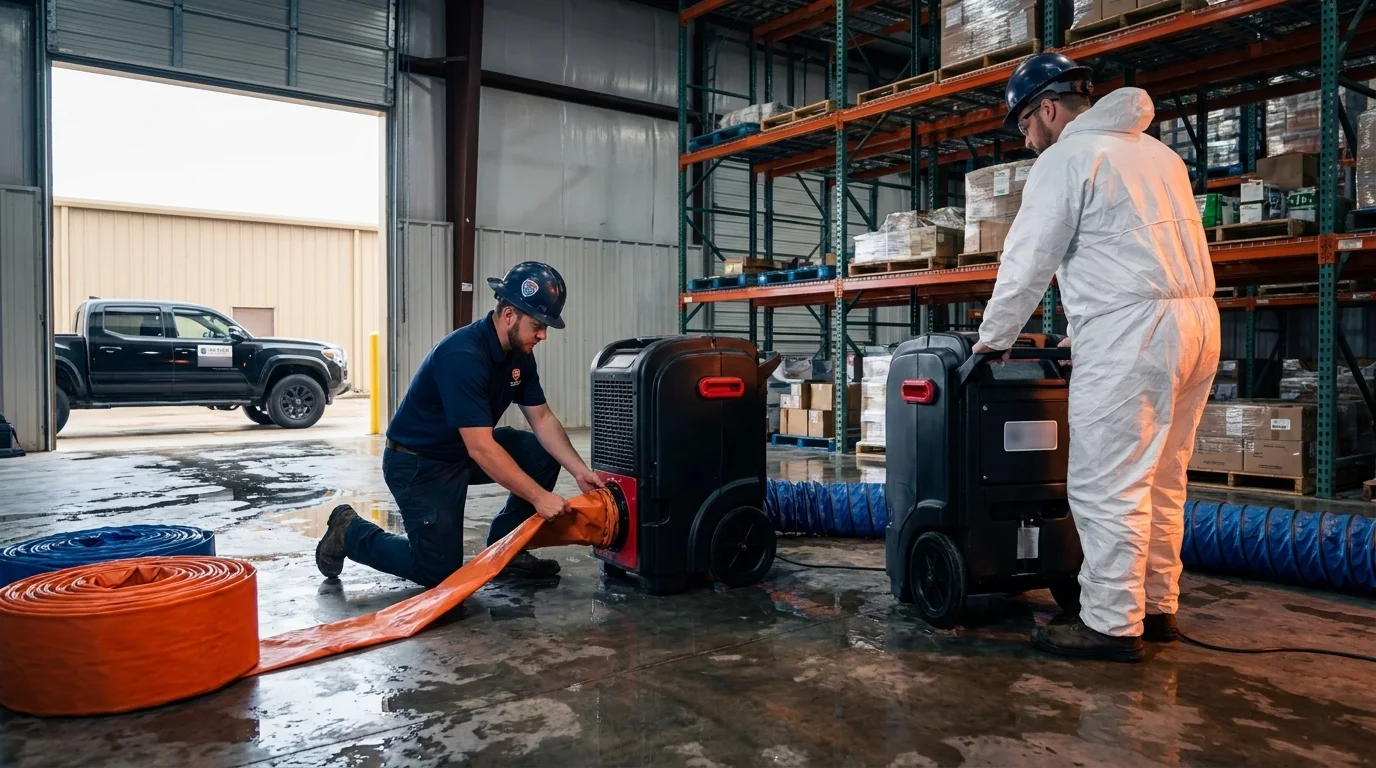
- Large-volume extraction and desiccant drying. High-bay spaces need more than a few air movers. We size drying equipment to the actual cubic footage, not the square footage, and use desiccant dehumidification where ambient humidity or outside air makes refrigerant units too slow.
- Equipment and asset protection. Machinery, control panels, and electrical infrastructure get inspected for corrosion risk early, since airborne moisture and combustion byproducts attack metal contacts and circuit boards faster than they damage building materials.
- Phased, zone-by-zone restoration. Where a full shutdown isn’t realistic, work is sequenced by zone so unaffected production or storage areas keep functioning while we clear and dry the loss area.
- Documentation for business interruption and carrier review. Moisture readings, thermal imaging, drying logs, and photos are compiled throughout, not just at closeout, since industrial claims almost always involve a business interruption component that residential claims don’t.
What separates a good industrial restoration response from a bad one
The most common failure on industrial jobs is under-equipping the space. A contractor used to residential water losses will bring the same three or four air movers and a single dehumidifier to a 40,000-square-foot warehouse floor, and the drying stalls because there simply isn’t enough dehumidification capacity for the air volume. Concrete slabs and tilt-wall panels also hold moisture far longer than drywall, and a moisture reading taken too early can read “dry” at the surface while the slab underneath is still saturated, which is exactly the kind of gap an insurance adjuster will flag later if humidity returns and mold or corrosion shows up weeks after the file was closed.
Corrosion is the other blind spot. Metal shelving, exposed rebar, electrical panels, and unprotected machinery can start oxidizing within days of a water event, especially with elevated humidity sitting in an enclosed space. A thorough response inspects and treats metal surfaces as part of the drying plan, not as an afterthought once the floor is dry. On fire losses, soot from burning plastics, packaging, and industrial materials behaves differently than residential soot, and it settles into HVAC systems and machinery internals in ways that require more than surface cleaning to fully remove.
What does industrial restoration cost?
Industrial losses vary enormously based on square footage, ceiling height, the type of construction, and whether machinery or inventory is involved, so any number here is a typical industry range, not a quote. Every facility gets a written scope of work before restoration begins, outlining the equipment, labor, and timeline specific to that loss. Commercial property insurance typically covers water and fire damage restoration and often business interruption costs, though coverage for inventory, machinery, and equipment failure varies by policy and should be confirmed with your carrier or broker.
| Scenario | Typical range |
|---|---|
| Localized water extraction, single warehouse zone | $3,000 - $9,000 |
| Large-volume desiccant drying, full production floor | $10,000 - $35,000+ |
| Smoke and soot remediation, loading dock or storage area | $5,000 - $20,000 |
| Corrosion mitigation for machinery and electrical panels | $2,000 - $8,000 |
| Full facility fire and smoke restoration | $25,000 - $100,000+ |
Seasonal & regional considerations
West Texas swings between flash flooding after heavy spring storms and long stretches of extreme summer heat, both of which stress industrial roofing systems, loading dock seals, and rooftop HVAC units. Flat or low-slope industrial roofs common on Abilene-area warehouses and manufacturing buildings are more prone to ponding and slow leaks than pitched residential roofs, and a leak that starts above a production line often isn’t noticed until product or equipment is already affected. Winter freeze events also put older sprinkler systems and exposed plumbing in unconditioned warehouse space at risk, which is when a fast response matters most to keep a burst line from shutting down an entire shift.
Service area
Air Care Restoration works with warehouses, manufacturing plants, and distribution facilities throughout Abilene and the surrounding region, including the industrial corridors along I-20 and the smaller communities that supply Abilene’s plant and logistics operations. Facility size and layout vary block to block in this area, from older brick industrial buildings downtown to newer tilt-wall construction on the city’s outskirts, and the drying plan is built around whichever one you operate.
If water, fire, or smoke has affected part of your facility, call (325) 339-8723 to get a crew on-site and a written scope of work started before the damage spreads to equipment, inventory, or the parts of the building still running.
Frequently Asked Questions
Does commercial insurance cover industrial water and fire damage restoration?
How long does it take to dry out a large warehouse or production floor after a water loss?
Can part of our facility keep operating while restoration work is happening?
How do you protect machinery and electrical systems during industrial water or fire damage restoration?
What kind of documentation do you provide for a business interruption claim?
Looking for the best industrial restoration company in Abilene?
Air Care Restoration provides licensed and insured industrial restoration in Abilene, TX and the surrounding area, and has served local property owners since 2026. Customers rate us 5.0 out of 5 stars across 22 Google reviews. We answer calls 24/7 — call (325) 339-8723 for immediate help.
Need Industrial Restoration now?
We respond 24/7 across Abilene and surrounding TX cities.
Related Coverage
- Our Restoration Services
- Contact Air Care Restoration
- Restoration Services in Albany
- Restoration Services in Anson
- Restoration Services in Baird
- Restoration Services in Ballinger
- Restoration Services in Bronte
- Restoration Services in Brownwood
- Restoration Services in Buffalo Gap
- Restoration Services in Clyde
- Restoration Services in Coleman
- Restoration Services in Colorado City
- Restoration Services in Comanche
- Restoration Services in Early