
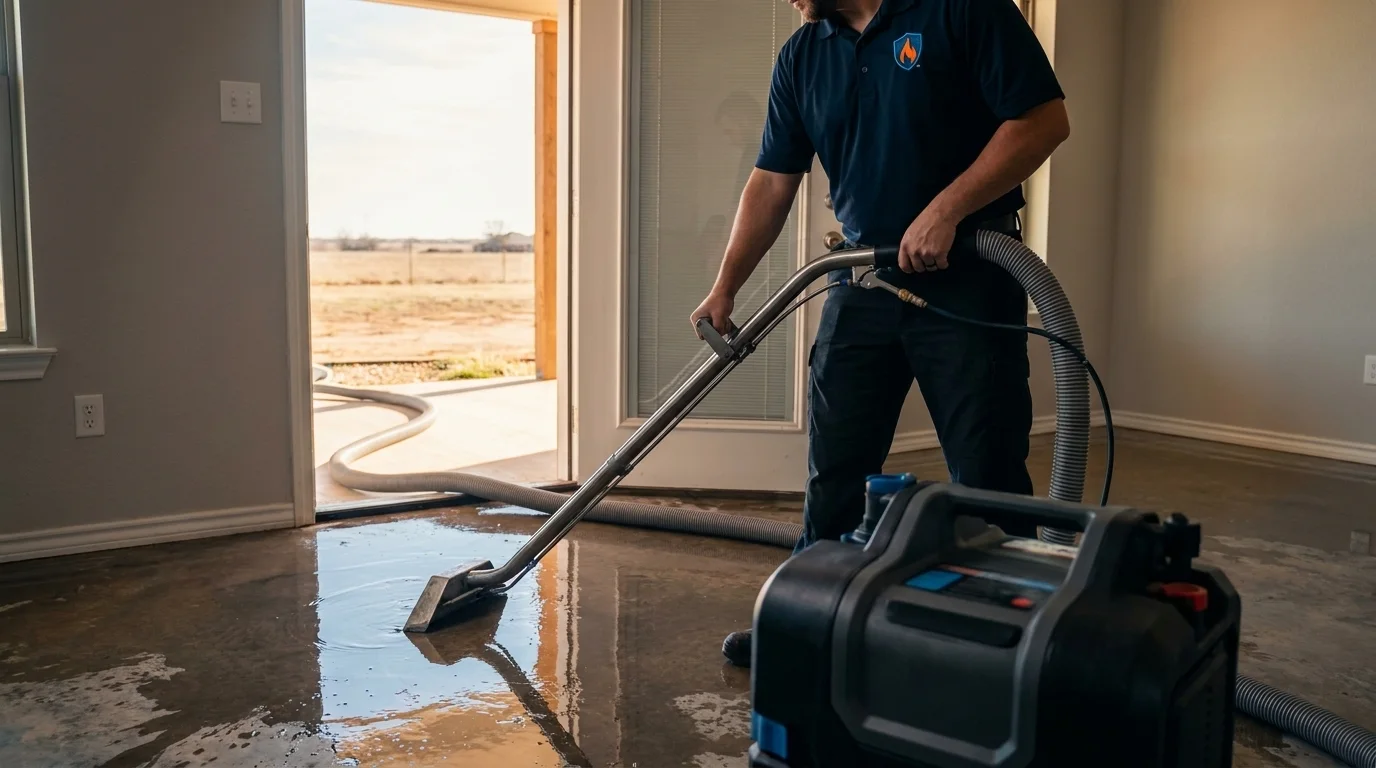
24/7 Emergency Flood Damage Restoration in Tye
24/7 emergency flood damage restoration in Tye, TX. IICRC-certified, insurance billing accepted. Call (325) 339-8723.
Our IICRC-certified technicians are dispatched from our Abilene, TX headquarters and are typically on-site in Tye within 60 minutes of your call.
Flooding emergency in Tye? We answer 24/7. Call now and our crew heads out to pump out the water and stop the damage from spreading.
Flat Rolling Plains terrain and clay-heavy soil mean water in Tye doesn’t always behave the way homeowners expect. A slab leak or heavy spring storm can push moisture sideways under a foundation for days before it ever shows up as a stain on the baseboard, and by the time carpet starts to feel spongy near an exterior wall, the drywall and insulation behind it may already be saturated. Air Care Restoration works flood and water losses across Taylor County, and Tye’s mix of manufactured housing, slab-on-grade ranch homes, and older frame construction each dry out differently.
Why Tye Properties See Flood Damage
Much of Tye sits on expansive clay soil typical of the Big Country region, the kind that swells when saturated and shrinks hard when it dries. That cycle stresses foundations and slab joints over time, which is why flood intrusion here often isn’t limited to a single storm event. A hard rain along the I-20 corridor can send runoff pooling against homes with older or undersized drainage, and once water finds a gap in a slab expansion joint or a low point in grading, it tends to keep returning after every heavy rain until the underlying path is addressed, not just the visible water. Homes built before modern vapor barrier standards are especially prone to slow subfloor saturation that isn’t obvious from the surface.
Our Flood Restoration Process in Tye
The first visit focuses on stopping active intrusion and mapping how far moisture has traveled, since Tye’s soil conditions mean water often spreads farther laterally than the visible wet line suggests. We pull moisture readings from baseboards, subfloor, and wall cavities rather than relying on what looks dry at the surface, because a wall can read dry at eye level while the plate and insulation below stay wet for days. Extraction equipment removes standing water first, then air movers and dehumidifiers are set according to the IICRC S500 drying standard, with daily monitoring so equipment placement can be adjusted as materials give up moisture at different rates. Where flooring or drywall can’t be saved, we document everything with photos and moisture logs before removal, both for the rebuild and for the insurance file.
Flood Insurance Coordination for Taylor County Homes
Most Tye homeowners without a federally backed flood policy are working through their standard homeowner’s coverage, and a lot of confusion happens right at the line between what counts as storm water intrusion versus a plumbing failure. We photograph the source of the water, the path it took through the structure, and the materials affected before any demolition starts, which gives the adjuster a clear record instead of a dispute. For manufactured and modular homes, which are common in and around Tye, we also flag skirting and underbelly damage separately, since that’s an area adjusters sometimes miss on an initial walkthrough.
Local note
A lot of Tye’s flood calls follow a pattern: a storm rolls through the I-20 corridor overnight, and the water doesn’t show up as a problem until the next afternoon once it’s had time to wick up through baseboards and laminate flooring. If you’ve had recent rain and just now notice a musty smell or soft spot in the floor, don’t wait to see if it dries on its own. Clay soil around Taylor County holds moisture against foundations longer than sandier soils do, so what looks like a minor puddle from the street can mean several more days of moisture working into the structure than you’d expect elsewhere.
If flood water has reached your home or business in Tye, Air Care Restoration is available 24/7 to start extraction and drying before the clay soil and West Texas humidity turn a wet floor into a mold problem. Call (325) 339-8723 for flood damage restoration built around how Tye homes actually dry, not a one-size-fits-all checklist.
Serving Tye from our Abilene headquarters — ★ 5.0 · 22 Google reviews
“Very efficient, very nice, great to work with.” — Callie, September 2026Read our reviews on Google →
Flood Damage Restoration in Tye: Service Coverage
Frequently Asked Questions
How fast can you arrive for flood damage restoration in Tye?
How does Taylor County's clay soil affect flood cleanup timelines in Tye?
Do manufactured homes in Tye need a different flood restoration approach?
Will my homeowner's policy cover flood damage from an I-20 corridor storm?
What's the IICRC S500 standard and why does it matter for flood drying in Tye?
Can flood damage in Tye turn into a mold problem quickly?
Will my homeowners insurance cover flood damage restoration in Tye?
Flood Damage Restoration response in Tye
Most Tye calls see a technician on-site within 60 minutes from our Abilene headquarters.